
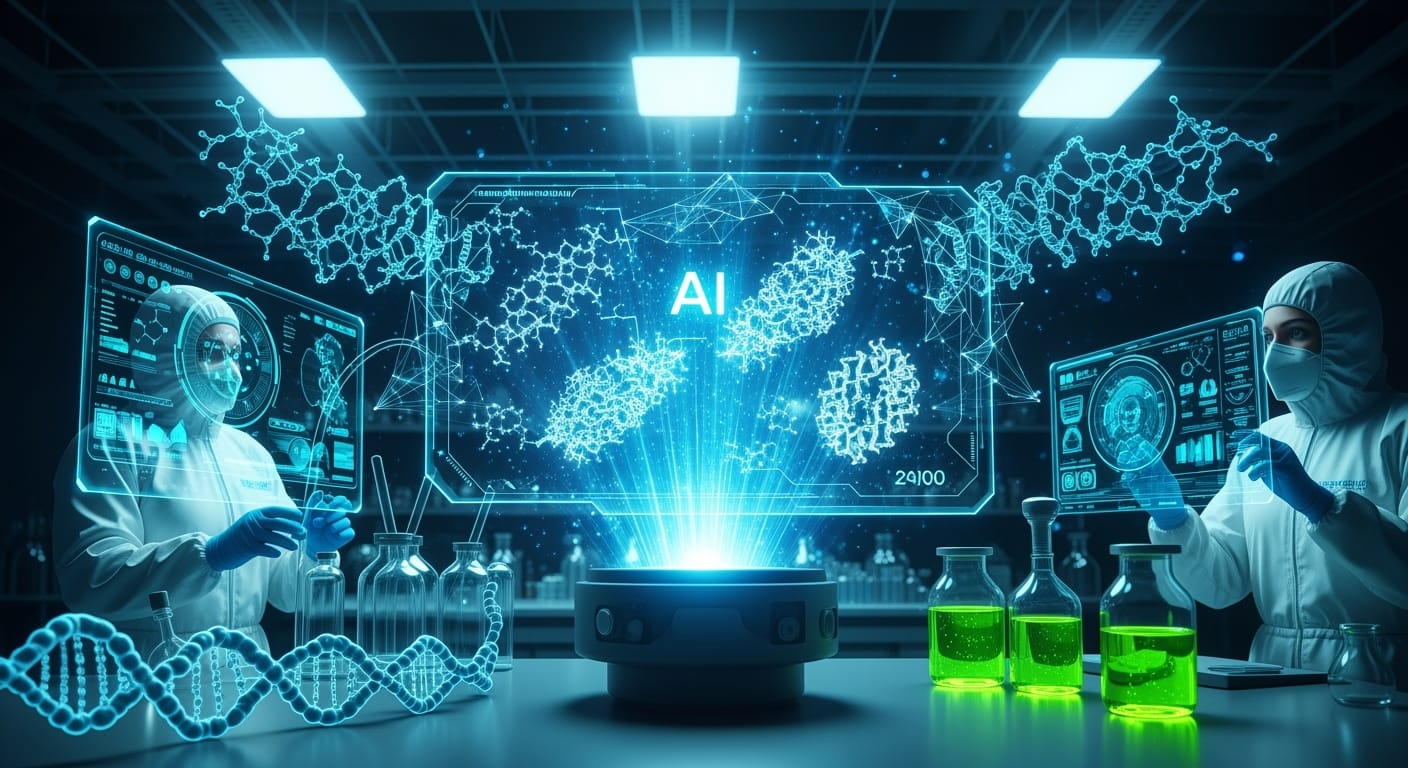
Artificial intelligence is reshaping how we approach drug discovery and medicine. In recent years, we have seen AI take on tasks that once relied on manual analysis and slow lab work. Today, advanced algorithms work through massive datasets faster than we can imagine. They spot patterns, predict results, and suggest promising compounds for further study. This allows us to test new ideas and treatments more quickly and at a lower cost.
AI helps us look at drug targets from new angles. It analyzes how diseases affect our bodies at the cellular and molecular level. This process uncovers connections we may not have noticed using traditional methods. By doing so, we can develop targeted drugs that treat the root causes of illness, not just the symptoms. The use of AI in developing new medicines is now a key part of how we fight disease.
How AI Transforms Medical Research
We can now process an enormous amount of genetic and clinical data with AI tools. These tools read and understand complex medical records, research papers, and clinical trial results. They help us make sense of patient histories and find the right treatment for each person. As a result, we can deliver more personalized care and improve patient outcomes.
With AI, we also gain the ability to simulate how drugs interact with the body. This predictive power allows us to spot side effects early. It cuts down on testing time in both animals and humans. The efficiency of this approach means we can bring drugs to patients faster. AI’s impact on medical research is only growing as we collect more data and develop better algorithms.
New Opportunities and Challenges Ahead
As we rely more on AI in drug discovery and medicine, we must also address new challenges. We need to ensure the quality of the data we use and avoid bias in our models. Privacy concerns and ethical considerations are becoming more important than ever. We must balance innovation with responsibility.
Still, the potential rewards are great. By integrating AI into our workflows, we open doors to treatments and cures that were once out of reach. The future of drug discovery and medicine depends on how we use and improve these powerful tools.
The Role of AI in Drug Discovery
Accelerating the Drug Discovery Process
Artificial intelligence is transforming the way we approach drug discovery. We now use AI to analyze vast datasets much faster than we could before. This efficiency helps us identify potential drug candidates in a fraction of the time.
By automating data analysis, we reduce the time needed for initial screening. AI models can suggest which molecules might interact with specific disease targets. This narrows down the number of compounds we need to test in the lab.
Machine learning algorithms spot patterns in biological data that humans might miss. We use these insights to prioritize promising drug candidates. As a result, we can move more quickly from discovery to clinical testing.
Enhancing Prediction and Reducing Costs
AI allows us to predict how new compounds will behave in the body. We feed large datasets into AI systems to forecast drug properties like toxicity and efficacy. These predictions help us avoid costly failures in later stages.
With improved predictive modeling, we can focus resources on the most promising leads. AI reduces unnecessary experiments and animal testing. This contributes to lower research and development costs overall.
The table below illustrates key benefits of using AI in drug discovery:
| Benefit | Description |
|---|---|
| Speed | AI shortens discovery timelines |
| Accuracy | Improves hit identification and validation |
| Cost Efficiency | Reduces lab and development expenses |
| Prediction | Forecasts efficacy and safety profiles |
Facilitating Innovation and Collaboration
AI opens new doors for innovation by analyzing complex biological networks. We can identify new therapeutic targets faster. This leads to the discovery of drugs for diseases that previously lacked treatments.
Collaboration is now easier, as AI platforms enable us to share insights across institutions. We can combine global data to improve model accuracy and uncover novel drug mechanisms. This collective approach increases our chances of finding effective medicines for complex diseases.
AI-driven drug discovery is reshaping our strategies and giving us powerful tools to address unmet medical needs.
Benefits of AI in Medicine
Improved Drug Discovery Efficiency
AI helps us process vast amounts of medical data quickly. We can identify promising drug candidates in less time. Machine learning allows us to predict how compounds interact with diseases. By using AI, we find patterns in data that humans might miss. This speeds up early-stage research and reduces the number of failed experiments. We can focus our resources on the most likely drug candidates.
AI systems can analyze millions of scientific articles and clinical trial data. This helps us stay updated on the latest discoveries. We can also use AI to model how a drug will behave in the body. This improves our success rates and helps us bring better medicines to patients faster.
Enhanced Personalization of Treatments
With AI, we can better understand patient differences at the genetic level. This allows us to tailor treatments to individual needs. Our models can predict which therapies will work best for each person. AI can help us identify biomarkers that signal a drug’s effectiveness. This leads to more precise and effective medical care.
AI-powered tools can sift through massive datasets from patient records. We use this insight to offer more targeted therapies. We can also reduce adverse drug reactions by predicting who is at risk. This personalization makes treatments safer and more efficient for everyone.
Better Decision-Making and Diagnostics
AI helps us make faster and more accurate diagnoses. We use algorithms to analyze images, lab results, and patient histories. This reduces errors and helps us catch diseases earlier. AI can flag critical cases for immediate attention, improving patient outcomes.
We rely on AI to support clinical decisions in real time. AI tools assist us in choosing the right medications and dosages. They also help us monitor patient progress and adapt treatments as needed. By using AI, we make medicine safer and more effective every day.
Challenges in Implementing AI in Drug Discovery
Data Quality and Availability
We often encounter challenges related to data quality and availability when using AI in drug discovery. Many datasets are incomplete, inconsistent, or siloed across various organizations. This fragmentation makes it difficult to train AI models effectively. Sometimes, data comes in different formats, which complicates integration. We also have to ensure that the data used is reliable and up-to-date, or our models might produce misleading predictions.
Privacy regulations create another barrier, especially with sensitive patient or genetic information. Sharing and accessing such data can be slow and complex. Missing or biased data leads to AI models that do not generalize well. These factors impact the overall robustness of AI in drug discovery.
Technical and Computational Hurdles
Developing AI models for drug discovery requires substantial computing power. Training large models with millions of parameters is expensive and slow. We must balance accuracy with computational cost, especially in smaller organizations with limited resources. Integrating AI tools with existing laboratory workflows can be complicated and time-consuming.
Another technical challenge is explainability. AI models, especially deep learning ones, often act as black boxes. We need to interpret model predictions to gain trust from scientists and regulators. Without clear explanations, it is difficult to make informed decisions about potential drug candidates.
Regulatory and Ethical Issues
Regulatory standards for AI-driven drug discovery are still evolving. We face uncertainty about how authorities will evaluate AI-generated results. Guidance on validation, approval, and oversight of AI tools is limited. This uncertainty makes pharmaceutical companies cautious when adopting new AI technologies.
Ethical concerns also arise when handling sensitive patient data. We must protect privacy while maximizing the utility of AI. Bias in data or algorithms can lead to unfair or unsafe outcomes. Addressing these issues is critical to ensure responsible and effective use of AI in medicine. Each of these challenges shapes how we integrate AI into drug discovery workflows.
Case Studies of AI in Drug Discovery
Accelerating Target Identification
AI has transformed how we identify new drug targets. For example, DeepMind’s AlphaFold has predicted thousands of protein structures. This has given researchers new insights into disease mechanisms. We can now map protein interactions that were impossible to see before. Drug companies use these insights to find and validate more precise targets. This speeds up the early research phase and reduces wasted time.
Pharmaceutical firms partner with AI startups to scan large datasets. These systems spot genetic patterns in diseases like cancer. Some companies used AI-powered algorithms to analyze COVID-19 viral proteins. This allowed for rapid vaccine and therapeutic candidate design. In several cases, the process took weeks instead of years. The efficiency and precision have changed how we start the drug discovery process.
Optimizing Drug Candidate Screening
Once we identify targets, AI helps us sift through thousands of potential drug molecules. Companies like BenevolentAI and Atomwise use machine learning for virtual screening. These platforms predict which molecules might bind best to a target protein. We only test the most promising candidates in the lab. This reduces lab experiments and resources required for each project.
In recent years, AI-driven systems discovered novel molecules for diseases like ALS and Ebola. A well-known case involves Insilico Medicine. Their AI system designed a new fibrosis drug candidate in less than 50 days. The speed and accuracy of these predictions would not be possible without deep learning. We are now able to move quickly from a computer model to a clinical trial.
Enhancing Drug Repurposing
Drug repurposing uses AI to find new uses for existing drugs. This approach saves time and money compared to developing drugs from scratch. AI analyses patient data and medical literature to spot new indications. For example, algorithms identified Baricitinib, an arthritis drug, as a potential treatment for COVID-19. The drug moved into trials with record speed.
We use machine learning to scan thousands of approved compounds. Patterns in clinical records often reveal hidden effects of old drugs. As a result, we can offer better treatments to patients using medicines that have already proven safe.
The Future of AI in Drug Discovery and Medicine
Accelerating Discovery and Personalization
We are witnessing a transformation in how drug discovery unfolds. With AI, we can process vast datasets at unprecedented speed. This capability allows us to identify new drug candidates faster. Machine learning tools help us predict molecule properties and optimize compound selection. This streamlining shortens timelines from years to months. AI-driven simulations also help us predict drug interactions and side effects with greater accuracy.
AI is pushing us closer to personalized medicine. By analyzing patient genetics and health records, algorithms can suggest therapies tailored to individual needs. This approach improves treatment outcomes and reduces trial-and-error. As we gather more real-world data, our predictive models will only get better. The future of drug discovery is not just faster but also more precise and patient-specific.
Enhancing Clinical Trials and Medical Research
AI is changing how we design and manage clinical trials. We can use advanced data analysis to identify the right participants based on genetic markers and health histories. This leads to more efficient trials and avoids unnecessary risks. AI-powered monitoring tools allow us to track patient responses in real time. We can quickly flag adverse events and adapt protocols as needed.
We are also seeing AI support in literature mining and hypothesis generation. By scanning scientific publications, AI identifies promising leads and research trends. This helps us prioritize projects with the highest potential impact. Our ability to aggregate and analyze global medical data is fueling rapid innovation.
Looking Ahead: Opportunities and Challenges
Despite these advances, integrating AI into medicine brings challenges. Data privacy and bias in algorithms require careful management. We need transparent and ethical AI systems to build trust among patients and health professionals. Collaboration between researchers, clinicians, and technology experts will be essential for responsible progress.
Looking forward, we expect regulatory agencies to develop new frameworks for AI-driven therapies. We anticipate even more breakthroughs as quantum computing and AI converge. As we embrace these changes, our role will be to guide AI toward solutions that benefit all patients and advance global health.
Conclusion
Reflecting on AI’s Role in Drug Discovery
As we explore the integration of AI in drug discovery, it becomes clear that technology is changing our approach. Machine learning and data analysis tools help us identify drug targets faster. These tools allow us to process large datasets in a fraction of the time. By doing so, we can make better decisions and reduce errors in the early stages of research.
AI also supports us in virtual screening and predicting molecular interactions. This helps us focus our resources on the most promising compounds. As a result, new drugs can be developed more efficiently. The traditional trial-and-error method is becoming less relevant as these innovations take hold.
Impacts on Medicine and Patient Care
AI’s impact extends into clinical practice and patient care. It helps us personalize treatments by analyzing patient data. This means we can offer therapies tailored to individual needs. Predictive models allow us to foresee patient outcomes and manage risks better.
We also see improvements in diagnosing diseases with AI-powered imaging tools. These systems assist clinicians in detecting conditions earlier and with greater accuracy. By using AI, we support healthcare providers and improve patient outcomes. The relationship between technology and medicine grows stronger every year.
Navigating Challenges and Future Directions
Despite these advances, we face important challenges. Data privacy and security remain top concerns. We must ensure that sensitive patient information is protected at all times. There are also questions about bias in AI algorithms that we need to address.
Looking forward, collaboration between researchers, clinicians, and technologists is crucial. By working together, we can refine our AI tools and enhance trust in these systems. We believe the future of drug discovery and medicine will continue to be shaped by AI-driven innovation.
FAQ
What role does AI play in the drug discovery process?
AI accelerates drug discovery by analyzing vast datasets quickly, identifying promising compounds, predicting drug behavior, and reducing the time and cost associated with traditional methods.
How does AI improve the accuracy and efficiency of drug development?
AI enhances accuracy by spotting patterns and predicting efficacy and safety profiles, which helps prioritize drug candidates and reduce unnecessary experiments and costs.
In what ways does AI contribute to personalized medicine?
AI analyzes genetic and clinical data to tailor treatments to individual patients, predicts therapy effectiveness, identifies biomarkers, and reduces adverse drug reactions.
How does AI support medical research beyond drug discovery?
AI processes complex medical records, research papers, and clinical trial data to improve diagnostics, support clinical decisions, and monitor patient progress in real time.
What are some challenges faced when integrating AI into drug discovery?
Challenges include data quality and availability issues, computational demands, model explainability, privacy concerns, ethical considerations, and evolving regulatory standards.
How does AI facilitate collaboration and innovation in medicine?
AI platforms enable sharing insights across institutions and combining global data, which improves model accuracy, uncovers novel drug mechanisms, and accelerates therapeutic target identification.
What impact has AI had on identifying new drug targets?
AI tools like AlphaFold predict protein structures and interactions, providing deeper insights into disease mechanisms and speeding up target validation.
How does AI optimize drug candidate screening?
Machine learning predicts which molecules best bind to targets, reducing the number of compounds tested in labs and accelerating the transition from discovery to clinical trials.
What is drug repurposing, and how does AI enhance it?
Drug repurposing uses AI to find new uses for existing drugs by analyzing patient data and literature, saving time and costs compared to developing new drugs from scratch.
How does AI improve the design and management of clinical trials?
AI identifies suitable participants, monitors patient responses, flags adverse events, and adapts protocols in real time, leading to more efficient and safer trials.
What are the ethical and regulatory considerations related to AI in drug discovery?
Ensuring data privacy, avoiding bias, maintaining transparency, and meeting evolving regulatory standards are critical to responsible AI use in medicine.
What technical hurdles must be overcome to effectively use AI in drug discovery?
Significant computational resources are required, integrating AI with lab workflows can be complex, and improving the explainability of AI models is necessary for trust and decision-making.
How does AI impact patient care and diagnostics?
AI supports faster, more accurate diagnoses, predicts patient outcomes, assists in treatment decisions, and helps personalize therapies to improve safety and effectiveness.
What future advancements are expected in AI-driven drug discovery?
Emerging technologies like quantum computing combined with AI promise further breakthroughs, while ongoing collaboration and ethical management will shape future progress.



0 Comments